We've all been there.
You receive an email that says:
"Mandatory Training Assigned."
You open the course.
Click Next.
Read a slide.
Click Next again.
Watch a video while checking your phone.
Answer a few quiz questions.
Complete the course.
Close the browser.
And a week later...
You barely remember what you learned.
Was the problem the learner?
I don't think so.
The problem was the learning experience.
Early in my career as a teacher, I learned something that has stayed with me throughout my journey into technical writing, content strategy, and learning design.
People don't remember everything you teach them.
They remember how you made them feel while they were learning.
The lessons that stayed with my students weren't always the most detailed.
They were the ones that sparked curiosity.
The ones connected to real life.
The ones that invited conversation instead of simply delivering information.
Years later, when I began designing learning experiences for organizations, I noticed something surprisingly familiar.
Adults aren't much different.
They don't want another 60-slide presentation.
They don't need another document filled with jargon.
They don't learn because someone tells them to.
They learn because they understand why it matters.
That realization completely changed the way I approach learning design.
Today, before creating a course, writing training content, or building learning resources, I don't start by asking,
"What information do we need to include?"
Instead, I ask,
"What problem are we helping someone solve?"
Because learning isn't about transferring information.
It's about building confidence.
A new employee doesn't want to memorize policies.
They want to feel capable on their first day.
A manager doesn't want another compliance course.
They want their team to succeed.
A technician doesn't need a hundred-page manual.
They need the right answer in the right moment.
When we design learning around people instead of presentations, something incredible happens.
Learning becomes memorable.
It becomes practical.
It becomes meaningful.
Over the years, I've had the opportunity to create onboarding resources, technical documentation, knowledge articles, learning content, and digital training experiences. Whether I'm working with subject matter experts, engineers, or business leaders, one principle always guides my work:
If learning doesn't change behavior, it hasn't truly happened.
Completion rates are important.
Quiz scores are useful.
But neither tells the full story.
The real measure of success is what happens after the course ends.
Did someone feel more confident?
Did they solve a problem faster?
Did they make fewer mistakes?
Did they leave believing they could do something they couldn't do yesterday?
That's the kind of impact I strive to create.
Because learning isn't about checking a box.
It's about opening a door.
A door to new skills.
New confidence.
New opportunities.
As someone who began her career in a classroom and later found a home in technology, I've come to realize that I never stopped teaching.
The classroom simply became different.
Today, my students are employees, customers, and users.
My lesson plans have become learning journeys.
And my goal remains exactly the same:
To make learning feel less like an obligation and more like an opportunity.
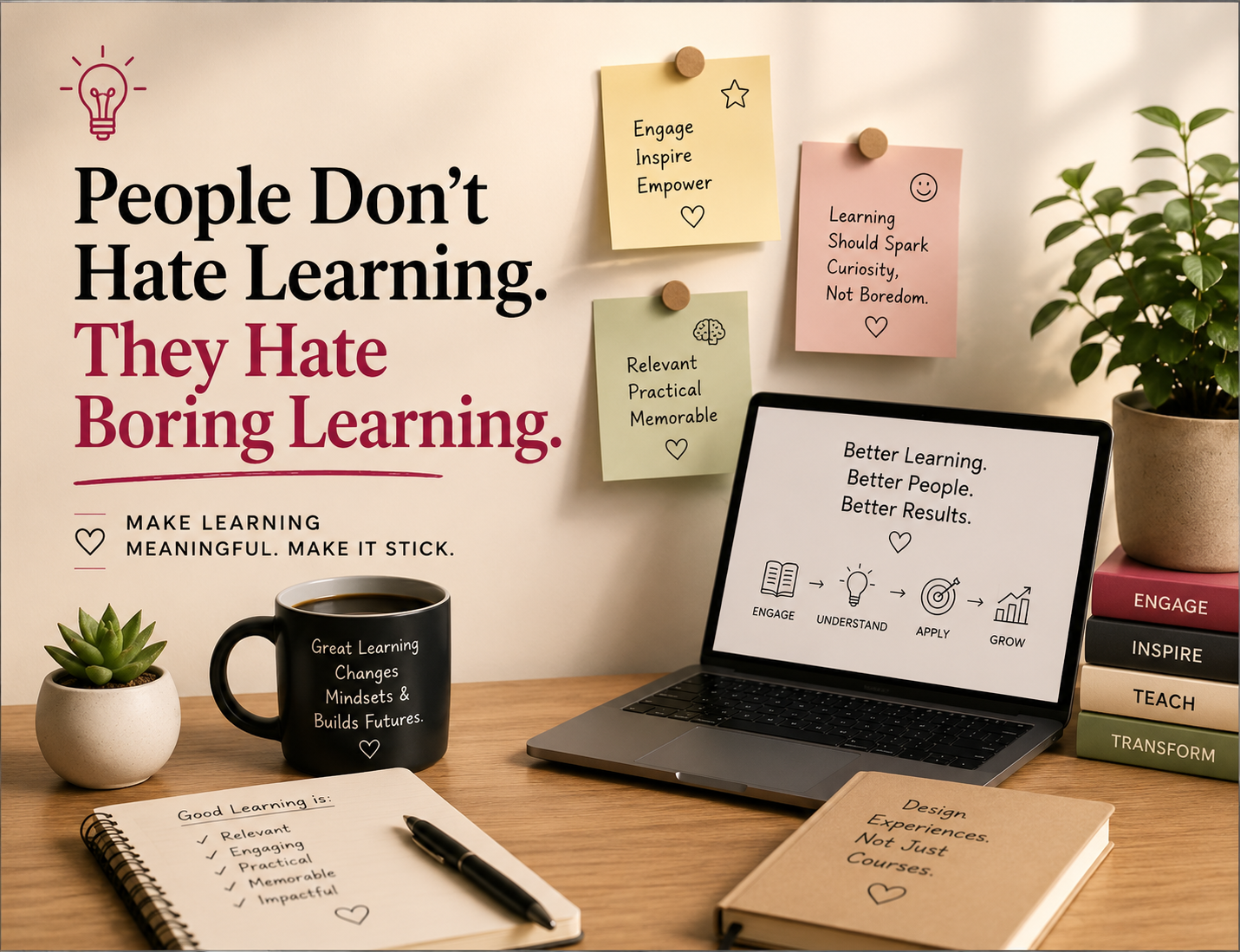
Because people don't hate learning.
They hate forgetting why it matters.
And when we design learning with empathy, curiosity, and purpose, we don't just create courses.
"We create experiences that people remember long after they've clicked "Complete."